

Quick Answer
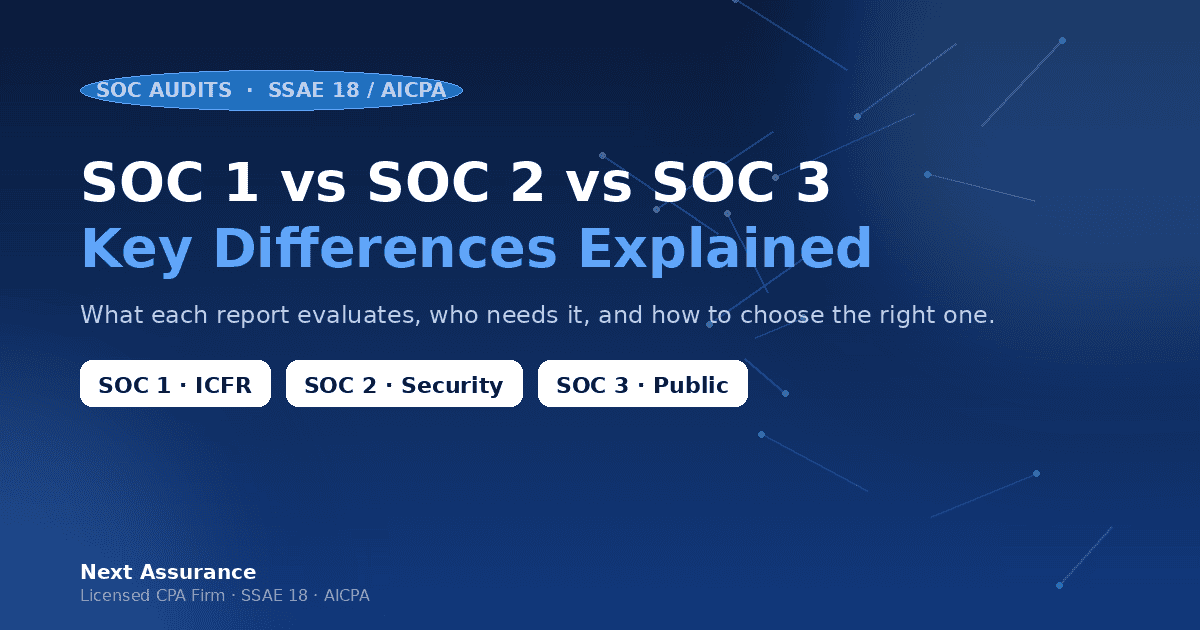
- SOC 1 evaluates controls over financial reporting (ICFR) — needed if your service impacts clients’ financial statements.
- SOC 2 evaluates security, availability, confidentiality, processing integrity, and privacy — the standard SaaS and tech companies need.
- SOC 3 is a public, simplified version of SOC 2 — safe to publish on your website, with no confidential technical detail.
- All three are issued under the AICPA’s SSAE 18 standard by a licensed CPA firm.
Choosing between a SOC 1, SOC 2, or SOC 3 report is one of the first questions any service organization faces once a client, investor, or external auditor starts asking for assurance over its controls. All three come from the same AICPA attestation framework, but they evaluate different things, serve different audiences, and are not interchangeable.
This guide compares the three reports in detail so you can identify — based on the type of service your company provides and who is asking for it — which one you actually need.
What Is a SOC Report?
SOC stands for System and Organization Controls. It’s a family of attestation reports that only a licensed CPA firm can issue, used by a service organization to demonstrate — with evidence verified by an independent auditor — that its internal controls are reliable.
The reason there are three versions is simple: not every control a client cares about is the same type, and not every report is meant to circulate freely. SOC 1 focuses on financial controls, SOC 2 on security and availability, and SOC 3 is a public summary of SOC 2, without sensitive data.
SOC 1: Financial Reporting Controls
A SOC 1 report, issued under the SSAE 18 standard (AT-C Section 320), evaluates a service organization’s internal controls over financial reporting (ICFR). In other words: it answers whether your company’s processes reliably affect the financial statements your clients report.
It’s the report typically requested by your clients’ external auditors when your company processes, calculates, or holds information that ends up reflected in their accounting.
- Who needs it: accounting BPOs, payroll processors, financial/accounting SaaS platforms, clearing banks, e-invoicing, trusts, and funds.
- Type I: evaluates the design of controls as of a specific date.
- Type II: also evaluates operating effectiveness over 6 to 12 months — the most requested by external auditors.
- International equivalent: ISAE 3402, recognized outside the United States.
SOC 2: Security and Trust Services Criteria
A SOC 2 report evaluates an organization’s controls against the AICPA’s five Trust Services Criteria: security, availability, processing integrity, confidentiality, and privacy. Unlike SOC 1, it’s not about financial data — it’s about how well your company protects clients’ data and systems.
Today, it’s the most commonly requested report by enterprise clients before signing a contract with a SaaS provider, and it’s often a de facto requirement to sell to mid-size and large companies in the U.S.
- Who needs it: SaaS companies, cloud infrastructure providers, fintechs, payment processors, and any company storing client data on its own systems.
- Type I: design of controls at a given point in time.
- Type II: operating effectiveness over an observation period — the standard most security and procurement teams require.
- Content: a detailed, confidential report, meant to be shared under an NDA with clients and prospects, not published.
SOC 3: The Public Report
A SOC 3 report is based on the same audit as a SOC 2, but removes the sensitive technical detail of the controls and the tests performed. The result is a high-level summary — with the auditor’s opinion — that any company can publish freely, without needing an NDA from whoever reads it.
- Who needs it: companies that already have a SOC 2 and want to use the compliance seal on their website, marketing, or sales proposals without exposing the full technical detail.
- Relationship to SOC 2: it doesn’t replace SOC 2 — it’s typically issued alongside it, as a “public distribution” version.
- Typical use: “Trust & Security” pages (Trust Center), initial sales questionnaires, and marketing materials.
SOC 1 vs SOC 2 vs SOC 3 Comparison Table
| Criteria | SOC 1 | SOC 2 | SOC 3 |
|---|---|---|---|
| What it evaluates | Internal financial reporting controls (ICFR) | Security, availability, integrity, confidentiality, privacy | Same as SOC 2, in summarized form |
| Audience | Your clients’ external auditors | Clients and prospects, under NDA | General public |
| Is it public? | No | No (restricted use) | Yes |
| Types | Type I and Type II | Type I and Type II | Single (based on a SOC 2 Type II) |
| Typical companies | Accounting BPO, payroll, financial ERP | SaaS, cloud, fintech, payment processors | Any company with an active SOC 2 |
How to Choose the Right Report for Your Company
The question that really decides which one you need isn’t “which is better,” but “what are my clients or auditors actually asking for, and why?” As a quick guide:
- If your processes directly impact your clients’ financial statements (payroll, accounting, invoicing, trusts): you need SOC 1.
- If your clients ask about your security, availability, or data handling before signing a contract (typical in SaaS and technology): you need SOC 2.
- If you already have a SOC 2 and want to publicly showcase your compliance on your website or sales materials: complement it with a SOC 3.
Many organizations — especially fintechs and payment platforms — end up needing more than one, because a single service can have both financial impact and expose sensitive data at the same time.
Frequently Asked Questions
Can I have a SOC 1 and a SOC 2 at the same time?
Yes. They aren’t mutually exclusive — they evaluate different aspects of your operation, and many companies need both if their service has financial impact while also handling sensitive client data.
Which one should I get first if I’m just starting out?
It depends on who’s asking. If it’s an enterprise client evaluating your security before signing, start with SOC 2. If it’s your client’s external auditor evaluating financial impact, you need SOC 1.
Does SOC 3 replace SOC 2?
No. SOC 3 is a public-distribution complement; the full SOC 2 remains the document that clients with stricter security requirements will still ask for under NDA.
How long does it take to get each report?
A Type I (SOC 1 or SOC 2) can be completed in 1 to 1.5 months from kickoff. A Type II requires an additional 6-to-12-month observation period. SOC 3 is issued alongside the corresponding SOC 2 Type II, with no significant extra time.
Not sure which report your company needs?
Our team can review how your organization operates and recommend the right type and scope — at no cost.
Request a Free Consultation →